Categories

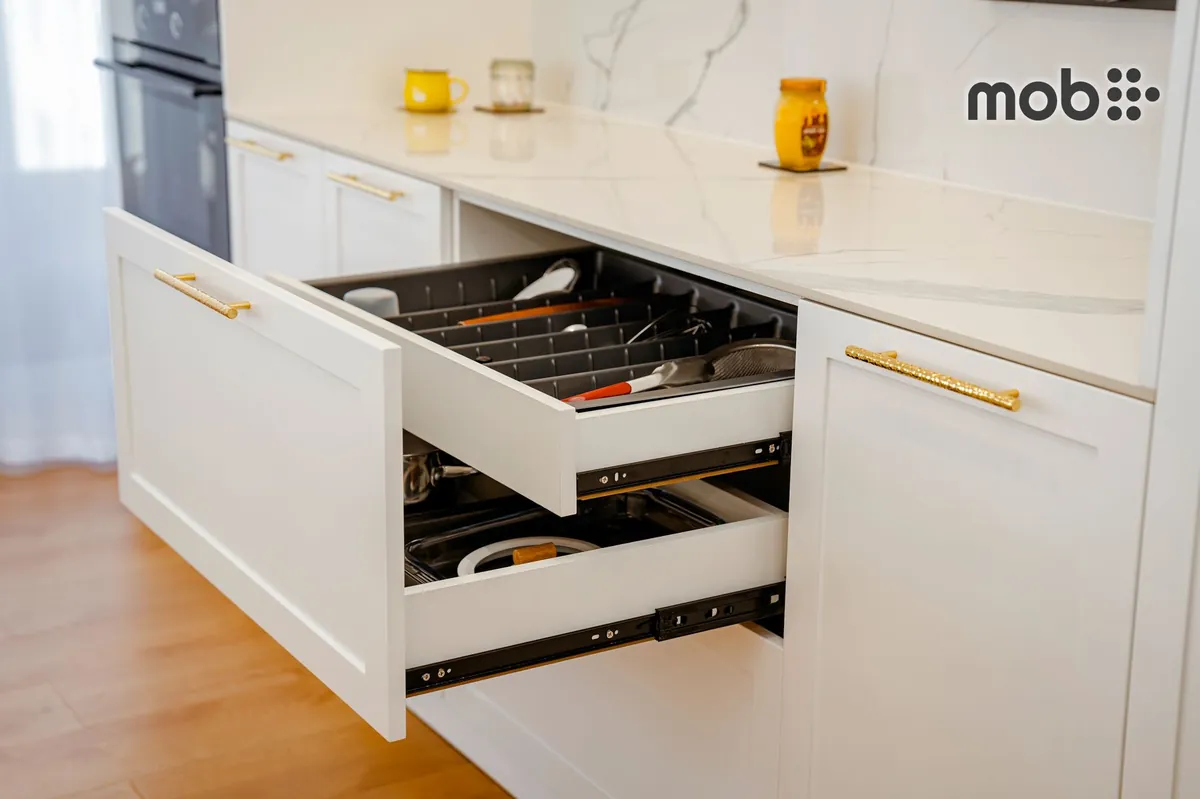
For any kitchen drawer carrying over 20 kilograms of dead weight, the tandem box wins completely. If you mount a deep pot drawer, an atta tub, or a stacked thali pullout on ordinary side-mounted telescopic channels, the drawer will jam, sag, or grind within a year. Telescopic channels belong on shallow cutlery trays and lightweight upper drawers, not beneath your heavy cookware.
The failure happens because of basic site physics that showroom catalogues gloss over. When a client pulls out an 800 mm wide drawer loaded with cast-iron pans and brass vessels, the entire 30kg mass hangs in the air 500 mm away from the cabinet carcass. That cantilever force twists side-mounted ball bearing slides until the steel tracks pinch against each other.
I have seen hundreds of kitchen handovers across Bengaluru where contractors cut corners by fitting generic telescopic channels on every base drawer to keep quotation totals down. Six months later, the homeowner calls back because the pot drawer needs two hands and a knee kick to shut. The choice between these two fittings is not a matter of luxury; it is a question of structural load paths.
The physics of the jam: cantilever leverage and track twist
A standard telescopic channel, often called a ball bearing runner, mounts directly to the vertical sides of your cabinet carcass and the external sides of your plywood drawer box. It relies on two or three nested steel rails separated by rows of small steel ball bearings sitting in plastic cages.
When the drawer is shut, the load pushes down vertically on the bearings, where the steel profile is strongest. But pull that drawer out to its full 500 mm extension, and the load transforms into a brutal lever. The downward pull on the front lip translates into an upward pry on the rear of the slide and a violent rotational torque along the side walls.
Thin sheet steel simply cannot resist that torsional twist. A telescopic slide made from 1.0 mm or 1.2 mm cold-rolled steel flexes outward under this dynamic twisting force. The moment the outer raceway sags by even half a millimetre, the steel ball bearings lose their aligned tracks. They slide instead of roll, biting directly into the raw steel wall. That friction is the grinding scratch you feel through the handle right before the slide locks up completely.
A tandem box avoids this entirely by placing the mechanical runners directly underneath the drawer base. The weight of your steel pots pushes straight down into the heavy-gauge undermount beams, transferring load into the cabinet carcass without subjecting the runner profile to twisting stress. The drawer runners stay parallel because they carry compression, not side torsion.
Where each fitting fails in an Indian kitchen
Kitchen hardware on an Indian site faces conditions European hardware labs never test for: spilled turmeric, fine atta dust, high cooking steam, and aggressive floor-mopping water. Here is how both systems behave under actual kitchen life:
- Telescopic channels fail from dust and grease migration. The ball bearing raceways on side-mounted channels are exposed directly to the internal cabinet air. Cooking vapour carrying airborne oil settles on the factory petroleum grease, turning it into a sticky paste. Once fine wheat flour or dry spice particles settle into that paste, the ball bearings freeze. Wipe the grease away with kerosene, and the dry steel races pit and corrode within weeks.
- Telescopic channels fail from side-racking during off-centre pulls. Nobody pulls a 900 mm wide drawer from the dead centre every single morning. If you grab the handle from the far right corner, a telescopic system racks diagonally. One slide compresses while the opposite slide pulls forward, causing the internal ball retainers to skip teeth and jam the drawer midway.
- Tandem boxes fail when water rots the wooden bottom plate. A tandem box uses steel double-walled sides, but the floor and rear back-panel are cut from standard 16 mm or 18 mm plywood or particleboard. If your sink plumbing develops a slow seep that creeps into the adjoining base cabinet, an unsealed plywood base swells. The swollen ply warps the bottom edge, throwing the undermount locking clips out of square.
- Cheap tandem knock-offs fail at the soft-close piston. Premium tandem units use internal gear racks that keep both left and right tracks mechanically synchronized. Cheap copies eliminate the rack and rely solely on an oil piston. Once that miniature fluid seal blows under heavy impact, the soft-close feature dies and the drawer slams shut on raw metal stops.
The fake 45kg rating and the dangerous substitution
Go into any hardware market in Bengaluru and pick up a generic 45 mm black-finish telescopic channel. The label or the cardboard sleeve will boldly claim a '45 kg load capacity'. That rating is a dangerous half-truth that ruins modular kitchens.
That manufacturer rating is a static test figure. It measures the weight a stationary, fully closed slide can support across an evenly distributed testing jig before shearing off the screws. It does not measure dynamic cyclic load. When a human jerks an unevenly packed drawer open ten times a day, dynamic shock loads spike to double the static weight. An ordinary 45 mm slide rated at 45 kg static will warp rapidly under a real-world 25 kg moving load.
The most damaging substitution on site happens when contractors swap a specified tandem drawer system for a standard stainless steel wire basket mounted on side-rail telescopic channels. To the client during the design walkthrough, both look like deep pullouts for utensils. But a wire basket mounted with side clips puts all stress on two tiny screw points per side. Under thirty kilograms of heavy brass kadhais and steel plates, those tiny screws slowly wallow out their pilot holes in the carcass, leaving the basket permanently crooked.
Carcass screw tear-out: ply face vs integrated 3D brackets
Hardware is only as strong as the wood fibre gripping the screws. The mechanical attachment of a telescopic slide is its weakest structural link.
Telescopic channels rely on small countersunk wood screws driven straight into the interior face of the cabinet carcass. In typical modular construction, that carcass is made from 18 mm commercial ply, MDF, or prelaminated particleboard. Under continuous vertical vibration and lever action, the screw threads chew the core of the board into loose sawdust. Once the middle screw loosens by two threads, the slide dips, and no amount of tightening will fix it because the hole is stripped.
Tandem boxes distribute that weight across heavy steel mounting brackets that sit against the cabinet floor and side, using multiple offset fixings to avoid splitting the timber grain. Furthermore, tandem boxes incorporate three-dimensional adjustment cams built directly into the metal drawer cheek. Turn a screwdriver on the hidden front cam, and you can lift, lower, or tilt the drawer fascia by two millimetres without unscrewing a single fitting from the wooden carcass. You cannot adjust a sagging telescopic drawer without unscrewing the channel and drilling new pilot holes.
When telescopic channels are the right call
Tandem boxes are an over-engineered waste of budget if you use them for every single compartment in a kitchen. Telescopic channels are entirely sensible for specific low-load applications where their slim profile saves internal storage width.
Use quality telescopic channels for shallow cutlery drawers where the total weight of spoons, forks, and knives rarely exceeds five kilograms. They are ideal for dedicated spice pullouts that measure only 150 mm or 200 mm wide, because the narrow frame prevents racking and side-twist. They also work perfectly for under-counter appliance shelves, like a pullout tray for an OTG or microwave, where the shelf remains parked during operation and only slides out for rear servicing.
A balanced kitchen layout puts tandem boxes on the lower two tiers where the heavy thalis, pressure cookers, and bulk groceries live, while reserving smooth telescopic slides for the top drawer tier. That split preserves your bank balance while guaranteeing that the drawers you yank open while cooking dinner slide effortlessly every single time.
Tandem Box vs Telescopic Channel Comparison
| Feature | Telescopic Channel (45mm Heavy Duty) | Tandem Box System |
|---|---|---|
| Mounting position | Side-mounted to carcass and drawer box | Concealed undermounted beneath drawer base |
| Safe dynamic weight | 10 kg to 15 kg realistic moving load | 30 kg to 65 kg tested dynamic load |
| Racking resistance | Poor on drawers wider than 600 mm | High; integrated rack or stabilizer bar keeps tracks in sync |
| Exposure to kitchen grit | High; open ball tracks trap oil mist and flour dust | Low; internal mechanical tracks are shielded under the base |
| Drawer alignment adjustment | None; requires re-drilling carcass screw holes | Tool-based 3D fascia adjustment (height, tilt, side-to-side) |
| Internal width loss | Takes roughly 25 mm total side clearance (12.7 mm per side) | Takes 40 mm to 50 mm total width due to double-wall cheeks |
| Cost to own ratio | Base hardware cost is a small fraction of the cabinet spend | Carries roughly three to four times the hardware cost per drawer |
Which one to buy
- Weigh the intended storage: if the contents include grains, atta containers, pressure cookers, or cast-iron pots, strike telescopic slides off your specification sheet immediately.
- Measure your cabinet width: any drawer opening wider than 600 mm needs an undermount tandem system to prevent uneven side-racking during daily use.
- Check the core carcass material: if your interior modular cabinets are built from particleboard or lower-density MDF, avoid heavy-load side-mounted telescopic runners completely because the screws pull out under cantilever torque.
- Specify synchronous runner mechanisms: when ordering tandem boxes for drawers 800 mm or wider, verify that the runner system includes a mechanical rack-and-pinion synchronization bar so both runners move together.
- Ensure waterproof base preparation: ensure your carpenter edges-bands all four raw edges of the 16 mm bottom plywood insert before snapping it into the tandem metal cheeks to prevent swell from mop moisture.
Compare current options and place orders onMadoverbuildings (MOB).
Pricing Snapshot
| Product | Live Price | MRP / RFQ | Buying Note |
|---|---|---|---|
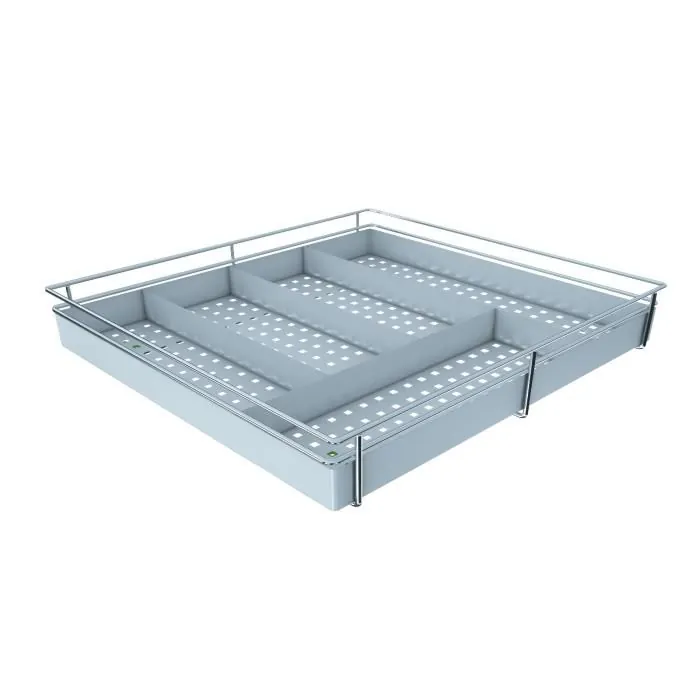
| Hettich Cargo Cutlery Basket W 386 386 x 500 x 94 mm, Article 9279342 | Rs 2,256.94 / Unit | MRP Rs 3,470 | RFQ Rs 2,235.65 | Stock: 98; Delivery: QWIK; Unit: Unit |
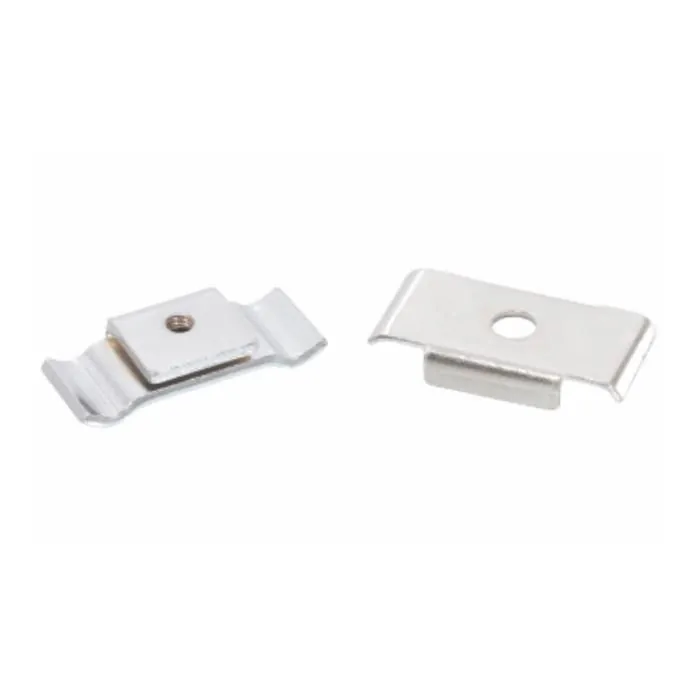
| Hettich CargoTech Clamps for KA, Article 1180142 | Rs 38.37 / Set | MRP Rs 59 | RFQ Rs 38.01 | Stock: 96; Delivery: QWIK; Unit: Set |
Don't substitute these
- Never squirt WD-40 or machine oil into a sticky telescopic slide; it washes out the thick factory bearing grease and turns loose kitchen flour into a grinding compound.
- If your carpenter claims a 45 mm telescopic runner will easily handle your heavy kadhais, ask him how many warranty service visits he will provide in writing after year one.
- Always leave at least 3 mm vertical clearance between drawer fascias so minor seasonal settlement never causes the front panels to rub against each other.
How This Plays Out on Madoverbuildings (MOB)
A residential contractor handling a four-apartment fitout in Sarjapur needed to upgrade twelve base cabinet drawers from basic runners to heavy-load systems after the client revised their storage layout for cast-iron cookware. He cross-checked the load ratings and depth profiles directly on Madoverbuildings (MOB), confirmed the required sizes and clamps for delivery to the site, and placed the order with clear GST invoicing before the carpentry crew assembled the carcass units.
Relevant Products to Compare

Frequently Asked Questions
Which drawer runner is best for heavy utensils in Indian kitchens?
A tandem box system is the correct choice for heavy utensils like pressure cookers, iron kadhais, and stacked steel plates. The undermount concealed slides support load from the base rather than stressing side screws, preventing the drawer from sagging or jamming under 30kg to 50kg weights.
Why does my kitchen drawer get stuck halfway when pulled open?
A drawer jams halfway when the side-mounted ball bearing channels twist under cantilever leverage, causing the steel tracks to pinch the bearings. It also happens when cooking grease mixes with ambient flour or spice dust inside the open raceways, physically blocking the balls from rotating.
Can I replace existing telescopic channels with a tandem box system?
You cannot simply screw a tandem box onto your old wooden drawer box because tandem systems use proprietary steel drawer sides with integrated undermount clips. You must build a new drawer floor and back panel to fit the specific tandem box profile, though the existing cabinet carcass can usually be reused.
Does hard water in Bengaluru corrode kitchen drawer runners?
Yes, airborne moisture and damp cleaning cloths carrying minerals from borewell water accelerate pitting on zinc-plated telescopic channels. The exposed steel ball bearings oxidize quickly once factory grease degrades, whereas tandem box runners are concealed and better shielded beneath the drawer bottom.