Categories

If your building in Bengaluru runs on unsoftened borewell water with TDS crossing 600 ppm, buy an exposed wall mixer. Do not put a concealed diverter inside that brickwork unless the client has already signed off on an automated central water softener. The wall mixer wins the site reality test because you can service, desolder, or swap it entirely in forty minutes with two spanners without breaking a single vitrified tile.
Walk into any three-year-old apartment block along Sarjapur Road, Whitefield, or Varthur, and you will see the same script play out. The architectural render had a neat single-lever concealed plate with an 8-inch rain shower. Within twelve months, the borewell's dissolved calcium and magnesium carbonates weld the internal ceramic disc cartridge into an immovable lump.
When that cartridge seizes inside a wall, the homeowner is either left with a shower that permanently drips warm water into the bucket or facing an ugly masonry excavation. Before you finalise the plumbing drawing or sign off on bathroom procurement, you need to know what that borehole water actually does inside the brass casting.
What 800 to 1400 ppm TDS actually does to a ceramic cartridge
Plumbing catalogs show smooth ceramic discs sliding effortlessly over polished silicone grease seals. That design assumes municipal Cauvery water running at 150 to 250 ppm Total Dissolved Solids. Borewells drilled down 900 to 1200 feet in East and South Bengaluru pump water carrying 800 to 1500 ppm TDS, paired with total hardness levels regularly topping 400 mg/L as CaCO3.
Here is the mechanical failure sequence. Every time the shower is turned off, a thin film of water sits trapped between the alumina ceramic moving plates. As the bathroom warms and cools, water evaporates, leaving behind crystalline calcium carbonate and silica scale. These crystals are harder than brass and abrasive enough to score ceramic faces ground flat to sub-micron tolerances.
Within six months, the micro-scratches destroy the hydro-seal, causing internal water bypass where hot and cold water cross-bleed inside the valve body. By twelve months, calcium crust builds around the nylon drive spindle and the brass retaining collar. The lever turns stiff, the user puts extra leverage on the handle, and the spindle snaps clean off at the neck.
Concealed diverter: the hidden risk buried behind 30mm of tile and mortar
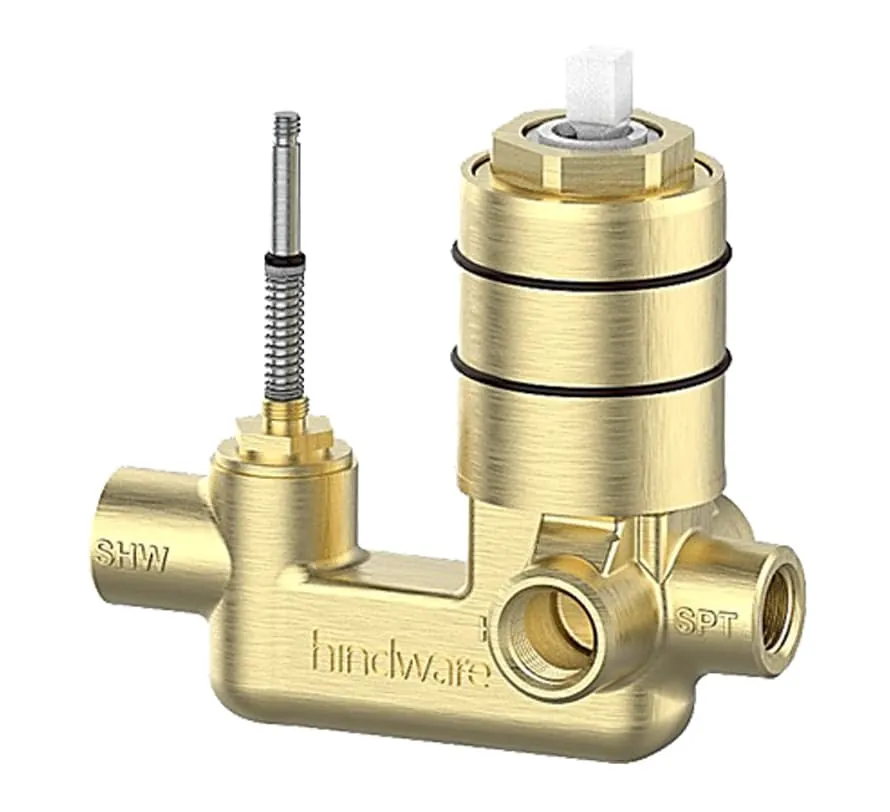
A concealed body like the Jaquar ALD-CHR-079N or Hindware F860107DCP is an exceptional piece of brass engineering, but it is built to live inside a wall cavity. It sits recessed 45mm to 65mm deep inside brickwork, locked in by tile adhesive, waterproof plaster, and expensive wall tiles.
When borewell scale locks the cartridge, you pull off the external flange plate and try to unscrew the brass retaining bonnet nut. If the plumber who installed it did not apply high-grade silicone grease to the brass threads during roughing-in, galvanic scale binds the brass nut to the forged body. The technician applies torque, and if the body shifts even two millimetres inside the chase, you risk snapping the soldered CPVC transition elbow behind the wall.
The secondary failure point is the diverter button mechanism. A high-flow diverter uses an internal spring-loaded poppet or rotary spool to toggle water between the spout and the overhead shower. Fine borewell silt and mineral scale pack tightly into the poppet guide sleeve. First, the shower head starts trickling while the bucket spout runs. Then the button refuses to drop down when water pressure shuts off. Fixing that spool requires custom extraction tools that local handymen simply do not carry in their toolbags.
Wall mixer: why external brass remains the pragmatic contractor pick
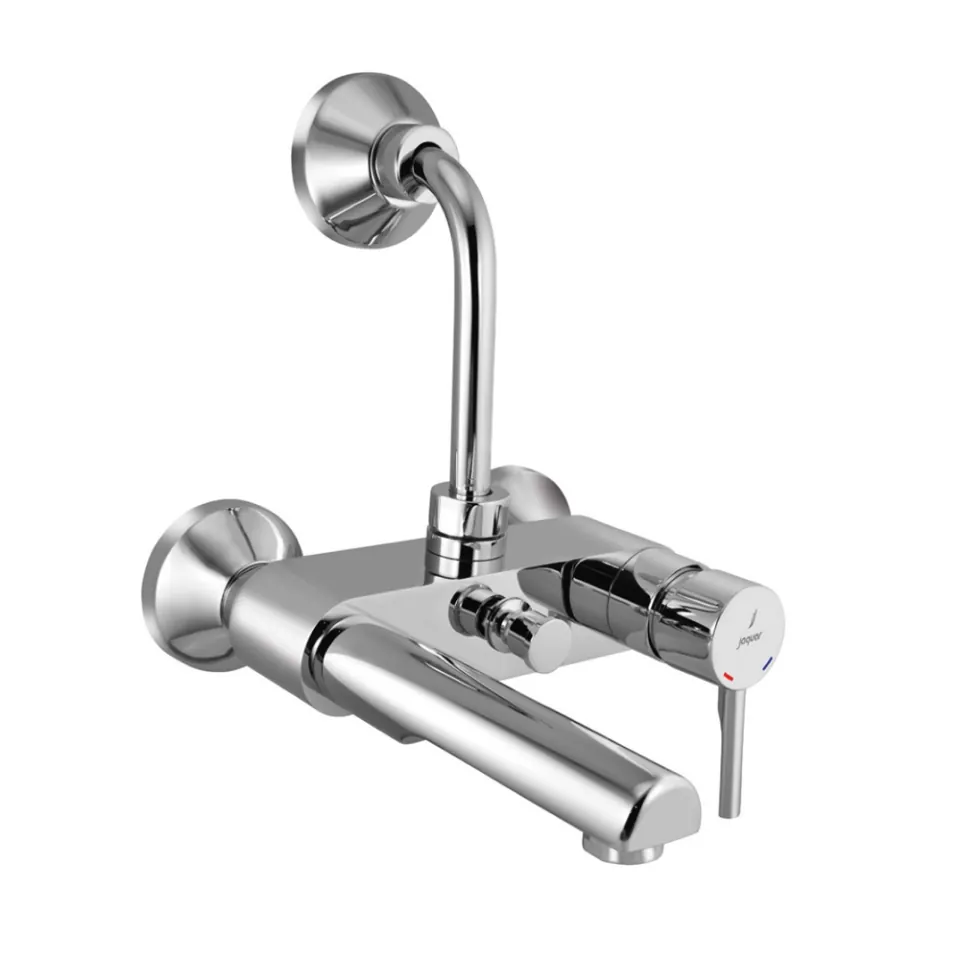
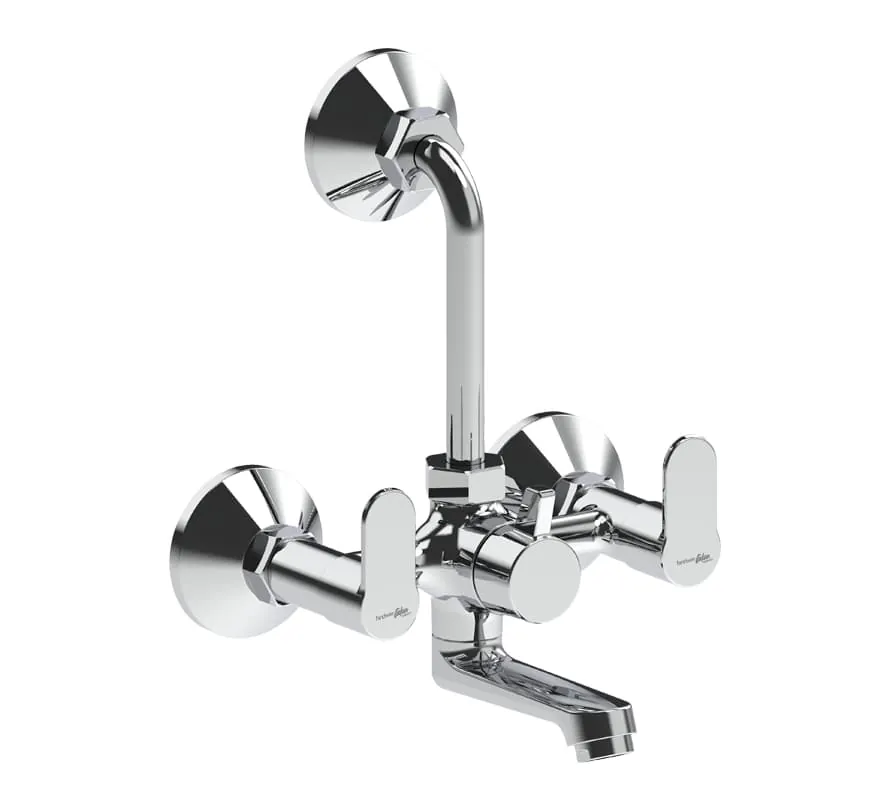
An exposed wall mixer, like the Hindware Studio F690020 or a single-lever Jaquar Florentine Prime FLP-CHR-5117PM, keeps the entire working mechanism outside the finished tile face. It mounts on two standard 1/2-inch CPVC female threaded elbows set at 150mm centre-to-centre distance, isolated by offset brass S-connectors (crank legs).
When the ceramic discs scale up or the internal washer perishes, the entire body can be unbolted in five minutes using an adjustable wrench. The homeowner can soak the valve overnight in a mild sulfamic acid or vinegar solution to dissolve calcium crusting without inhaling fumes inside an unventilated shower cubicle. If the casting pits or an internal thread strips, you buy a replacement unit off the shelf and bolt it back onto the existing wall flanges without touching tile grout.
There is also an installation margin that saves sites every week. If your rough plumbing mason set the inlet elbows slightly out of line, say 145mm instead of 150mm, or three millimetres out of level, the eccentric brass legs of an external wall mixer swivel to absorb the alignment error. With a concealed diverter body, if your rough-in is crooked, your finished trim plate will sit cockeyed against the tile forever.
The substitution mistake that destroys shower performance on site
The most common procurement disaster on high-TDS sites is substituting a regular-flow concealed diverter body for an overhead rain shower installation. A regular concealed shower mixer body has an internal waterway designed for a nominal flow of 12 to 15 litres per minute at 3 bar pressure. When paired with an 8-inch or 10-inch overhead shower head, the flow velocity drops drastically.
Because the flow is lethargic, water does not clear cleanly from the overhead shower nozzles when the tap shuts off. It dribbles out for ten minutes after the shower is done. In Bengaluru, that prolonged slow drip means borewell water sits inside the silicone shower nozzles, baking dry under bathroom lighting and calcifying every single outlet hole into solid chalk.
If you specify a concealed system, you must insist on a dedicated high-flow diverter body with minimum 40mm or 46mm cartridge capacity, rated for 35 to 45 litres per minute. Never let a supplier substitute a standard basin mixer cartridge or a compact bath mixer valve body simply because the external trim plate from the same cosmetic series happens to click into place.
Water pressure, overhead tanks, and the booster pump trap
Concealed diverters require clean, balanced hydraulic pressure to work their mixing chambers properly. If your overhead tank sits on the terrace only 2.5 metres above the bathroom shower head, the gravity head is roughly 0.25 bar. A single-lever high-flow diverter drops significant pressure across its ceramic ports; under weak gravity head, the hot and cold water balance wanders wildly every time someone opens a kitchen tap downstairs.
The standard fix on site is dropping an automated pressure booster pump on the terrace line. But in high TDS areas, a booster pump accelerates cartridge wear dramatically. High-velocity water loaded with micro-crystals of quartz and calcium acts like liquid sandpaper against the internal seals. Within six months, the O-rings are chewed up.
An exposed wall mixer with independent ceramic quarter-turn valves or a wide-bore single lever has far lower internal restriction. It operates reliably under modest gravity heads of 0.5 to 1 bar without forcing you into buying and powering a booster pump that continually chews through mineral-laden water.
Concealed Diverter vs Wall Mixer: Performance on High TDS Water
| Factor | Concealed Diverter (High Flow) | Exposed Wall Mixer | Site Reality Winner |
|---|---|---|---|
| Aesthetics & Cleanliness | Flush minimalist wall plate; pipework completely invisible behind tile | External brass body with visible spout, riser bend, and pipe flanges | Concealed Diverter |
| Cartridge Lifespan on >800 TDS | 8 to 14 months before stiffness, micro-scratching, or cross-bleed begins | 12 to 18 months before scaling; easily soaked or cleaned in place | Exposed Wall Mixer |
| Repair & Tile Risk | Bonnet nut can seize inside casting; risk of damaging tiles during stubborn repairs | Zero tile risk; unbolts from external crank legs in minutes | Exposed Wall Mixer |
| Plumbing Rough-In Tolerance | Zero margin; body must be set perfectly square, level, and at exact plaster depth | High margin; eccentric S-connector legs absorb 10mm centre spacing errors | Exposed Wall Mixer |
| Low Gravity Pressure Handling | Requires minimum 1.5 to 2.5 bar pressure; often demands a booster pump | Functions smoothly even on 0.5 to 1.0 bar terrace gravity head | Exposed Wall Mixer |
| Initial Installation Complexity | Requires deep wall chaser cuts, pressure testing before plaster, strict box depth | Simple two-point female elbow rough-in at standard 150mm spacing | Exposed Wall Mixer |
Which one to buy
- Test the site water for TDS and Total Hardness before drawing bathroom rough-in lines. If TDS is above 600 ppm and hardness exceeds 300 mg/L with no central softener planned, standardise on exposed wall mixers.
- If using a concealed diverter, verify the depth marking on the plastic protective box. Plaster and tile thickness must end strictly between the minimum and maximum cut lines stamped on the casting.
- Coat the internal brass bonnet threads and cartridge collar generously with food-grade silicone grease before closing the wall, so mineral scale cannot weld the metal threads together.
- Ensure the plumber installs accessible dual-inlet service check valves or angle cocks with fine stainless steel mesh strainers upstream on both the hot and cold lines feeding the bathroom.
- Before tiling, pressure-test the concealed diverter body at 8 to 10 bar for a minimum of 24 hours to rule out joint weeping inside the masonry chase.
Compare current options and place orders onMadoverbuildings (MOB).
Pricing Snapshot
| Product | Live Price | MRP / RFQ | Buying Note |
|---|---|---|---|
| Hindware Body Of Hi-Flow Single Lever Concealed Mixer & Diverter For Bath & Shower System W/O Sleeve Cat. No. : F860107DCP | Rs 3,257.63 / Unit | MRP Rs 4,250 | RFQ Rs 3,257.63 | Stock: 100; Delivery: QWIK; Unit: Unit |
| Jaquar - Concealed Body for Single Lever High Flow Diverter - ALD-CHR-079N | Rs 3,693.50 / Unit | MRP Rs 4,550 | RFQ Rs 3,652 | Stock: 15; Delivery: QWIK; Unit: Unit |
| Jaquar Florentine Prime Single Lever Bath & Shower Wall Mixer with Overhead Shower Provision, 115 mm Bend Pipe, Chrome | Code: FLP-CHR-5117PM | Rs 8,544 / Unit | MRP Rs 10,800 | RFQ Rs 8,448 | Stock: 13; Delivery: QWIK; Unit: Unit |
| Hindware Studio Wall Mixer With L Bend Pipe For Overhead Shower, Cat. No.: F690020, Chrome | Rs 4,491.69 / Unit | MRP Rs 5,275 | RFQ Rs 4,491.69 | Stock: 92; Delivery: QWIK; Unit: Unit |
Don't substitute these
- Never soak a seized ceramic cartridge in straight commercial hydrochloric acid; it dissolves the brass spindle and ruins the synthetic lip seals within ten minutes.
- If your concealed diverter handle starts feeling gritty or hard to turn, service the cartridge that same weekend; waiting another month will shear the plastic drive square inside the lever.
- Always buy two spare manufacturer cartridges along with your concealed diverter trim kits; brass models get discontinued, leaving you with an obsolete internal body five years down the line.
- Check your hot-water input side on borewells; geyser heating accelerates calcium precipitation, so the hot port of your mixer will always seize before the cold port.
How This Plays Out on Madoverbuildings (MOB)
A residential contractor managing three villa builds off Sarjapur Road needed to confirm cartridge compatibility and body dimensions across both Hindware and Jaquar lines. He pulled the technical specs directly on Madoverbuildings (MOB), locked his plumbing quantities with clear itemised GST billing, and scheduled dispatch to match his rough-in plumbing timeline.
Relevant Products to Compare


Frequently Asked Questions
How does borewell TDS ruin a concealed diverter cartridge?
High TDS water contains dissolved calcium and magnesium carbonates that crystallise when water rests between the moving ceramic discs. These microscopic mineral crystals score the mirror-polished ceramic faces, destroying the seal and creating friction that locks the spindle.
Can I replace a concealed diverter cartridge without breaking bathroom tiles?
Yes, provided the rough-in depth was installed correctly and the brass bonnet nut has not seized with mineral scale. You remove the external lever and trim plate, unscrew the retaining nut with a box spanner, and pull the cartridge straight out through the tile cutout.
What is the minimum water pressure required for a high-flow concealed diverter?
A high-flow concealed diverter typically requires a working dynamic pressure of 1.5 to 3.0 bar to deliver proper spray coverage through a wide overhead shower. Operating below 1 bar results in weak flow and prevents automatic diverter buttons from resetting properly.
Why do wall mixers last longer than concealed diverters on hard water?
Wall mixers have shorter, wider internal flow channels that produce less turbulence and scale buildup, and their components sit outside the wall where heat dissipates faster. More importantly, when scaling occurs, the entire unit can be disassembled, descaled, or swapped without chiselling masonry.
Does a whole-house water softener prevent diverter cartridge failure in Bengaluru?
An ion-exchange water softener replaces calcium and magnesium ions with sodium ions, preventing scale crystals from baking onto the ceramic plates. While it does not reduce total TDS, it eliminates hardness scaling and dramatically extends cartridge life.
What is the standard centre distance between hot and cold inlets for a wall mixer?
The standard centre-to-centre distance for wall mixer inlets is 150mm (roughly 6 inches). The brass offset S-connectors included in the box provide an adjustment range of approximately 135mm to 165mm to correct rough plumbing variations.
Can I substitute one concealed option for the other on site?
Only if the drawing, pressure, and finish still match. A cheaper concealed substitute often fails at joints, water lines, or wet rooms. Ask the contractor which option the spec actually named.