Categories


Buy the 25 litre storage geyser if your bathroom has an overhead shower and two people bathe within the same hour during a chilly Bengaluru morning. A 15 litre unit cannot keep up with an 8-litre-per-minute shower head when winter inlet water drops to 15 degrees Celsius. The 15 litre tank runs lukewarm in four minutes flat, leaving the second person standing in cold mist.
If your household takes bucket baths or uses the bathroom strictly on staggered schedules, buy the 15 litre model instead. It reaches 65 degrees Celsius in twenty minutes, cuts down continuous electrical draw, and loses significantly less heat through the casing while sitting idle during the day.
The surprise on site is not the capacity. It is that both units almost always pack the exact same 2000-watt heating element. Choosing the 25 litre unit does not draw more electrical current at any given second, but it forces your 16A circuit to run at full load for nearly forty-five minutes straight, which is where poor wiring and weak breakers cook themselves.
Cold Inflow and Why the 15L Tank Collapses in Winter
In Bengaluru from November through February, overhead rooftop tank water easily drops down to 14 or 16 degrees Celsius. When you turn on your shower mixer, hot water leaves the top of the geyser while cold water instantly enters the bottom through the dip tube to replace it. A good geyser uses a deflector baffle over the cold inlet to prevent rapid mixing, but physics always wins.
A typical overhead shower nozzle delivers between 7 and 10 litres of blended water every minute. If you like a hot shower at roughly 40 degrees Celsius, about 60 percent of that flow comes straight out of the hot tank while 40 percent comes from the cold bypass. That means your geyser empties around 4 to 5 litres of its stored hot reserve every sixty seconds.
Do the math on a 15 litre tank. Within three to four minutes of running an overhead shower, half the tank volume has been swapped out for frigid borewell or Cauvery water. The internal thermostat senses the drop, the element kicks on, but a 2kW coil can only heat roughly 0.8 litres of water by 30 degrees Celsius per minute. The cold water floods in four times faster than the element can warm it up. By minute five, you are adjusting the mixer knob all the way to hot, and by minute seven, the water is cold. A 25 litre unit gives you roughly ten to twelve minutes of sustained, comfortable shower volume before the incoming cold water dilutes the core temperature.
The 16A MCB Mystery: It Is Duration, Not Wattage
Almost every residential storage geyser sold in India between 10 litres and 25 litres carries a rated power input of 2000 watts. A few performance models jump to 3000 watts, but 2kW is the undisputed builder standard. At 230 volts single-phase, a 2000W heating coil draws roughly 8.7 amperes of continuous current.
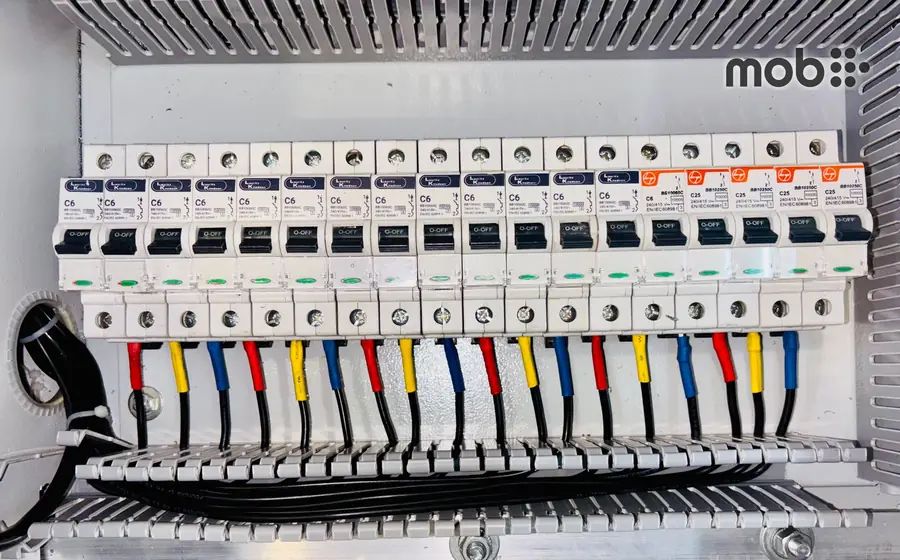
Contractors and homeowners often ask why their 16A Type-C MCB trips only when running a 25 litre geyser, assuming the larger tank pulled more power. It did not. Both sizes draw 8.7 amperes. The difference is running duration under thermal memory.
A 15 litre geyser warms up from cold to shut-off in roughly 18 to 22 minutes. A 25 litre geyser takes between 38 and 45 minutes to achieve the same temperature rise. Miniature circuit breakers rely on a bimetallic strip for overload protection. If an electrician looped the geyser point through a cheap 16A breaker sharing a box with bathroom exhaust fans, or tied it into an old 1.5 sq mm copper wire run instead of dedicated 2.5 sq mm cable, heat accumulates inside the enclosure.
After thirty minutes of continuous 8.7A draw through loose terminal screws or resistive undersized wire, the ambient temperature inside the distribution box spikes. The bimetallic strip bends under the trapped internal heat and trips the 16A breaker even though the load never crossed ten amperes. If your wiring is substandard or spliced inside wall conduits, a 25 litre geyser will find the flaw and drop the circuit every single morning.
Where 15L and 25L Fail on Site
- Water volume failure: The 15 litre geyser fails unconditionally when paired with multi-flow rain showers or large bathtubs. If your plumbing layout features a 200mm rain shower head, running a 15 litre storage geyser is a design mistake. You will spend every shower rushing against an emptying tank.
- Load and casing stress: The 25 litre geyser fails mechanically when wall anchors are treated like small mirror brackets. A 25 litre geyser weighs roughly 12 to 14 kilograms empty, and close to 40 kilograms when full of water. Mounting this weight on hollow AAC blocks using standard plastic rawl plugs leads to sheared fasteners and tilted brackets within two years. You must use 10mm or 12mm steel anchor bolts that pass deep into solid concrete or solid blockwork.
- Thermal standby loss: The 25 litre geyser fails on efficiency if mounted in a guest bathroom or a home where one person bathes per day. The larger outer surface area leads to standing heat loss of nearly 0.6 to 0.8 kWh over a 24-hour cycle compared to 0.35 kWh on a well-insulated 15 litre tank. If nobody uses that water, you are paying to heat the ceiling slab above the false ceiling.
- Pressure valve dripping: In Bengaluru high-rises where the hydrostatic pressure from the overhead terrace booster pump exceeds 5 bar, both units will weep water from the multi-function safety valve (MFV). However, 25 litre tanks expand more under thermal cycling, frequently blowing through cheap pressure relief seals if an inline pressure-reducing valve is omitted.
The Substitution That Destroys Your Bathroom: PVC Braided Hoses
The most dangerous substitution happening across Bengaluru bathroom installations right now is using cheap PVC-jacketed flexible connection pipes instead of genuine EPDM-lined stainless steel 304 braided hoses.
Plumbing supply counters often push white plastic braided hoses because they look clean, bend easily in tight corners, and feel like they will not corrode in hard water. They are fine for washbasin cold taps. They are disastrous on geyser hot outlets.
The water exiting the top of a 25 litre geyser during its peak cycle can easily hit 70 degrees Celsius if the thermostat drifts. Standard PVC hoses soften under heat. Combine 65-degree water with 4 to 6 bar of line pressure from a hydro-pneumatic pumping system, and the inner plastic tube blisters, balloons outward, and bursts cleanly off its brass crimp.
When this happens while you are away at work, the geyser empties boiling water onto your false ceiling, saturates the gypsum board, caves the bathroom ceiling in, and floods the flat below. Always insist on heavy-gauge SS 304 braided connection pipes with machined brass hex nuts and high-temperature EPDM core rubber, backed by brass hex nipples screwed into the wall elbows.
Reading the Spec Plate Before Mounting the Bracket
Before your plumber drives anchors into the tile, look at the metal specification sticker pasted on the side or bottom of the geyser outer shell. Do not rely on what is written on the cardboard carton.
- Check the rated pressure: It must state 8 Bar (0.8 MPa). If you live in an apartment tower with more than four floors, any unit rated at 6 Bar or less is an automatic reject that will leak at the tank welds within eighteen months.
- Verify the inner tank material: Look for glass-lined, vitreous enamel coated steel. Bengaluru borewell water in areas like Whitefield, Sarjapur, and Bellandur routinely clocks total dissolved solids above 800 ppm. Bare copper or unlined stainless steel tanks will suffer pinhole pitting corrosion from chlorides within three winters.
- Inspect the sacrificial anode size: The label should mention a heavy-duty magnesium anode rod. In hard water belts, this rod sacrifices itself to protect the steel tank. A skinny, undersized anode means the tank starts corroding the moment the rod dissolves in season two.
- Confirm the IP protection rating: Bathrooms generate heavy steam and splash. Look for IPX4 splash-proof certification on the casing. If it reads IPX1 or has no IP stamp at all, condensation inside the wiring chamber will trip your home RCD breaker repeatedly.
15 Litre vs 25 Litre Storage Geyser Comparison
| Feature | 15 Litre Storage | 25 Litre Storage | Site Reality |
|---|---|---|---|
| Ideal Bathing Type | Bucket baths or quick 4-minute hand showers | Continuous 8-to-12 minute overhead rain showers | 15L cannot sustain an 8 LPM overhead shower in Bengaluru winter |
| Reheat Time (15°C to 65°C) | 18 to 22 minutes | 38 to 45 minutes | Both use 2000W coils; volume dictates heating duration |
| Wall Load When Full | Approx. 22 to 26 kg | Approx. 38 to 42 kg | 25L requires genuine steel anchor bolts; plugs in AAC block fail |
| Electrical Demand on 16A MCB | 8.7A load for ~20 minutes | 8.7A load for ~45 minutes | Longer continuous heat exposes loose terminals and thin 1.5 sq mm wire |
| Daily Standing Loss | Lower heat radiation surface | 30-40% higher standing heat loss | 25L wastes more electricity if left on without back-to-back users |
| Vertical Ceiling Clearance | Requires 450mm to 500mm height | Requires 550mm to 650mm height | 25L frequently clashes with low false ceilings and trap doors |
Which one to buy
- Check your bathroom shower head flow rate using a bucket and stopwatch; if it fills a 10-litre bucket in under a minute, cross the 15L off your list.
- Inspect the bathroom electrical line at the distribution board to ensure the geyser runs on its own dedicated 2.5 sq mm copper wire with a genuine 16A C-curve breaker.
- Measure the clearance between your finished false ceiling and the plumbing inlet elbows; a 25L vertical geyser requires at least 600mm of free wall drop.
- Verify the incoming water pressure; if you reside on lower floors of a high-rise, order a brass pressure reducing valve alongside the geyser.
- Refuse plastic flexible pipes and secure two stainless steel 304 braided connection tubes with EPDM inner lining before the plumber leaves the site.
Compare current options and place orders onMadoverbuildings (MOB).
Don't substitute these
- Never mount a 25 litre geyser directly to a plasterboard partition wall; it must tie into RCC columns or solid structural masonry.
- If your 16A socket faceplate feels hot to the touch after 20 minutes, turn it off immediately; that is a loose copper terminal, not normal geyser heat.
- Drain your geyser tank through the safety valve drain port once every six months to flush out calcified white sediment before it coats the element.
- For false ceilings with less than two feet of vertical drop, buy a horizontal mounting storage model rather than squeezing a vertical tank sideways.
How This Plays Out on Madoverbuildings (MOB)
A site supervisor finishing a four-bathroom duplex in HSR Layout noticed the client had specced 25L vertical geysers, but the false ceiling drop left barely 480mm of vertical wall space. Sitting in his parked car with the morning chai, he opened Madoverbuildings (MOB), found the equivalent horizontal glass-lined 25L storage units with verified dimensions, and placed the order with the site GSTIN for morning dispatch.
Frequently Asked Questions
Can a 15 litre geyser support an overhead rain shower in Bengaluru?
No, it cannot support a standard overhead rain shower during winter months. An 8-litre-per-minute shower head exhausts the hot water reservoir of a 15L tank in roughly four minutes. You will need a 25 litre model for comfortable continuous showers.
Why does my geyser trip the 16A MCB after thirty minutes of heating?
The trip happens because of thermal buildup in the breaker box rather than an immediate short circuit. Drawing 8.7 amps continuously through loose wire terminals or an undersized 1.5 sq mm line heats the bimetallic strip inside the breaker until it drops. Tightening connections and upgrading to dedicated 2.5 sq mm copper wire solves the issue.
Does a 25 litre geyser consume more electricity than a 15 litre geyser?
It consumes more total kilowatt-hours simply because it heats ten additional litres of water and has a larger surface area losing heat throughout the day. However, both units pull the exact same 2000 watts of electrical power while the coil is active.
How much wall clearance is needed to install a 25 litre storage geyser?
You need a minimum vertical wall clearance of 600mm to 650mm, plus an extra 100mm below the unit to allow connection pipes to bend without kinking. Always measure below your false ceiling grid before ordering.