Categories


If your water heater turns on and immediately cuts power to every fan, light, and router in your home, your builder installed a single 30mA RCCB as your main incomer breaker. For personal safety in a wet bathroom, a 30mA trip threshold is non-negotiable. For the main incoming line of an entire apartment, a 30mA breaker is an engineering mistake. You need a two-tier setup: a 100mA RCCB on the main incoming supply for fire prevention, and a separate 30mA RCCB or RCBO dedicated strictly to the bathroom and kitchen wet circuits.
Every year around early November, electricians across Bengaluru get the exact same call. The homeowner flips the water heater switch at 6:30 AM on the first brisk morning, a sharp click echoes from the hallway metal box, and the whole house goes pitch black. The common knee-jerk reaction is to blame a faulty geyser element or assume the load is too high for the meter.
Load has nothing to do with it. An RCCB does not care how many kilowatts your geyser pulls; that is an MCB's job. An RCCB measures current leaking where it should not go. When you understand how Bengaluru borewell water eats metal heating elements and how modern electronics bleed current to earth, the fix becomes simple, clean, and permanent.
Why the first cold November morning trips your entire flat
In Bengaluru, water heaters often sit idle or run minimally through the humid monsoon months. During this downtime, the magnesium sacrificial anode inside the tank degrades, and the hard water common across Bellandur, Whitefield, and Sarjapur leaves heavy calcium carbonate crusts around the copper or incoloy heating sheath. Microscopic fissure cracks form in the outer sheath of the heating element as it cools and sits in mineral-heavy water.
When the first 15-degree winter morning hits and you switch on the geyser, two things happen simultaneously. First, cold water contracts the metal casing, drawing moisture directly into the magnesium oxide insulation powder inside the heating tube. Second, the sudden thermal expansion causes a sharp spike in capacitive and resistive current leakage straight into the tank water and out through the copper earthing conductor.
If your flat has a single 30mA RCCB guarding the main supply, that geyser leakage does not act alone. Your home already runs a baseline of standing earth leakage. Every phone charger, television power supply, laptop brick, inverter refrigerator, and LED driver contains small filter capacitors connected between line and earth to suppress electromagnetic noise. In an average 2BHK or 3BHK, these devices leak between 10mA and 18mA continuously without any defect present.
Now add your cold geyser element, which leaks roughly 12mA to 15mA for the first three minutes until the moisture boils out of the powder. The sum of your regular household leakage and the cold geyser leakage exceeds the 30mA limit. In reality, IS 12640 mandates that an RCCB rated for 30mA can trip at anything above 15mA. The breaker simply does what it was built to do: it drops the bar and cuts power to the entire house.
Where 30mA and 100mA fail on site
A 30mA RCCB fails when asked to shoulder aggregated circuit loads. When installed at the main incomer position after the energy meter, it suffers from nuisance tripping. Any distant thunderstorm, a damp balcony wall socket during driving rain, or running the washing machine while someone charges an electric scooter in the stilt parking will shut down your home. You cannot run a modern home with multiple switched-mode power supplies on a single 30mA incomer.
A 100mA RCCB fails when relied upon to save a human life from direct electrical contact. If your bare feet are wet on a damp bathroom tile and current passes from a cracked geyser element through the water jet and into your chest cavity, 100mA of current is fatal. The human heart enters ventricular fibrillation between 50mA and 100mA. At that amperage, muscles seize, preventing you from letting go.
A 100mA rating is engineered strictly for fire protection and equipment protection. A loose neutral or an arcing phase wire in a timber wardrobe or false ceiling can generate intense heat without ever pulling enough current to trip a standard 16A or 32A MCB. A 100mA residual current breaker catches this creeping leakage and cuts power before combustible materials ignite, but it will let a lethal shock pass through a human body in a wet room.
The correct two-tier distribution board layout
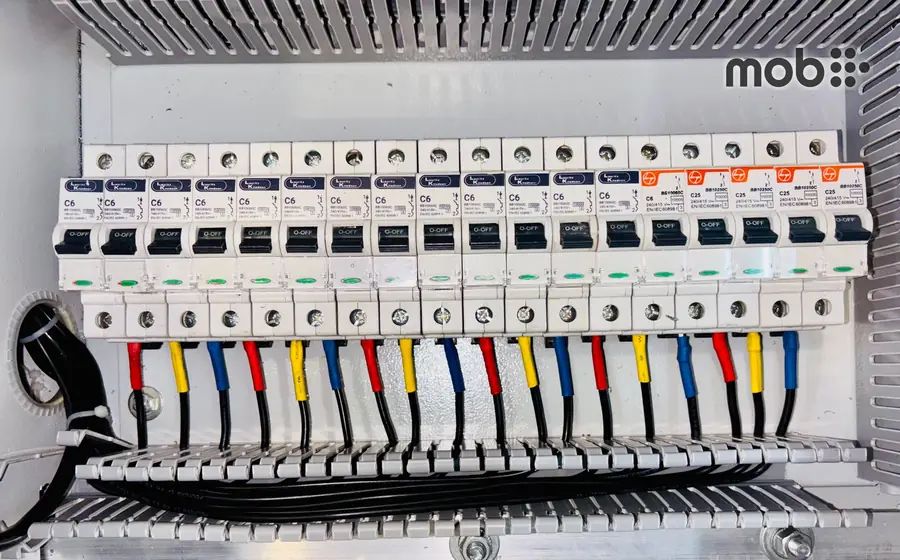
The standard way to wire a modern residential distribution board in India requires separating fire defense from shock defense. Your electrician should not force one breaker to do both tasks.
- Main incomer stage: Feed your incoming phase and neutral cables from the meter directly into a double-pole isolator or MCB, followed immediately by a 100mA RCCB (Class A or Class AC, rated for 40A or 63A continuous load). This unit stays put and only trips if a major cable sheath burns through or moisture penetrates structural walls.
- General power and lighting: Route all bedroom, living room, lighting, and general socket circuits through individual miniature circuit breakers fed directly from the busbar after the 100mA incomer.
- Wet area sub-distribution: Create an isolated bus section or install a dedicated compact RCBO (a combined MCB and RCCB in a single DIN module) rated at 16A or 20A with 30mA sensitivity specifically for the bathroom water heater, another 30mA unit for the kitchen counter sockets, and another for the washing machine area.
Under this design, if your geyser element suffers a micro-leak on a chilly morning, only that single bathroom circuit trips. Your desktop computer stays on, your refrigerator keeps running, and your home does not plunge into dark chaos while you troubleshoot.
The deadly lookalike: MCB vs RCCB vs Isolator
Walk into any local hardware lane and you will find double-pole devices sitting in neat rows in cardboard cartons. To an untrained eye, a 32A double-pole MCB, a 32A double-pole Isolator, and a 32A 30mA RCCB look almost identical. They all clip onto the standard 35mm DIN rail inside your distribution box. They all have a grey or white plastic face and a toggle lever.
One common site mistake during budget interior jobs is substituting an isolator or an ordinary MCB where the drawing specified an RCCB. An isolator is merely a mechanical switch; it trips on nothing at all. An MCB only trips when current exceeds its threshold (such as drawing 40 amps through a 16-amp breaker) or when a dead short occurs between phase and neutral.
If an electrical charge leaks through water dripping down your geyser body into the metallic shower braid, the leakage current might be only 0.2 amps. That 0.2 amps is plenty to kill a person, but an MCB will treat it as negligible and stay firmly on. Never let a contractor swap an RCCB for an MCB to stop nuisance tripping. If your 30mA device keeps tripping, fix the element or split the circuits; do not remove the safety net.
How to read the faceplate: IS 12640, sensitivity, and type
Before your electrician snaps an RCCB into the distribution enclosure, inspect the markings stamped across the front panel. Do not rely on the sticker on the box.
- Check the sensitivity value: Look for the text 'IΔn' followed by either 0.03A or 0.1A. A value of 0.03A means 30mA (human personal protection). A value of 0.1A means 100mA (equipment and fire safety).
- Look for the breaker type symbol: Most budget builds use Type AC (marked with a small sine wave icon), which only detects pure alternating leakage currents. However, modern variable-speed inverter water heaters and kitchen appliances generate pulsed direct current leakage. For wet zones containing electronic controls, choose Type A (marked with a sine wave above a pulsating half-wave pattern).
- Check the continuous rating: The number before the type letter (like 25A, 40A, or 63A) is the current the contacts can carry without melting. This must be equal to or greater than the upstream MCB rating.
- Test button compliance: Every genuine RCCB built to IS 12640 (Part 1) or IEC 61008 contains a small push button marked 'T' or 'Test'. Pressing this introduces an artificial internal leakage. If pressing the button with the main power on does not instantly drop the lever, the internal mechanism is jammed or burnt out. Replace it immediately.
30mA vs 100mA RCCB: Technical and Application Differences
| Option | Best for | Watch out | When to choose |
|---|---|---|---|
| 30mA RCCB | Direct personal protection against lethal shock in wet zones (bathrooms, kitchens, outdoor sockets). | Will cause regular nuisance trips if used as the single main incomer for a whole house due to accumulated standing leakage. | Choose for dedicated sub-circuits feeding water heaters, water pumps, washing machines, and bathroom outlets. |
| 100mA RCCB | Preventing electrical fires, cable sheath tracking, and protecting fixed heavy building wiring. | Will not protect human life from ventricular fibrillation or lethal shock in direct contact scenarios. | Choose as the master incomer breaker directly following the main isolator in domestic apartments and independent floors. |
Which one to buy
- Open your distribution box cover and check if you have a single RCCB for the entire flat or sub-circuit protection.
- Verify the IΔn rating printed on the face: 0.03A for individual bathroom lines, 0.1A for the incoming mains.
- Press the mechanical test button on each installed RCCB with the power running to verify that the internal spring releases.
- If your 30mA main breaker trips when the geyser starts, have an electrician test the circuit for background standing leakage using an earth leakage clamp meter.
- Split your distribution board by keeping a 100mA breaker at the incoming position and adding an independent 30mA RCBO for the geyser line.
Compare current options and place orders onMadoverbuildings (MOB).
Don't substitute these
- Never bypass an RCCB by looping neutral directly to the bar to fix a morning trip; that turns your shower pipe into a live hazard.
- In hard water pockets of Bengaluru, replace your geyser heating element and magnesium anode every two seasons before mineral encrustation cracks the outer sheath.
- Check your inverter wiring: a shared neutral between the home circuit and inverter output will trip an RCCB the second utility power fails.
How This Plays Out on Madoverbuildings (MOB)
A residential electrical contractor running a renovation in Indiranagar ran into constant trip calls because the original DB had a single 30mA incomer. Instead of hunting through three physical market streets for matched RCBOs, he pulled up Madoverbuildings (MOB), confirmed the verified stock of 16A 30mA Type A breakers for the bathroom sub-circuits, and checked out with clear GST invoices for the client handover.
Frequently Asked Questions
Can a 100mA RCCB protect you from an electric shock?
No, a 100mA breaker does not provide personal shock protection. Current levels between 50mA and 100mA passing through the body can stop the heart or trigger fatal ventricular fibrillation. A 100mA unit is meant solely for equipment and fire prevention.
Why does my geyser trip the RCCB only in winter?
Water heaters sit idle or run briefly during warmer months, allowing moisture to penetrate micro-fissures in the mineral-scaled heating element insulation. On cold mornings, this moisture causes an initial leakage spike to earth, which pushes your flat's accumulated standing leakage past the breaker limit.
What is the difference between an RCCB and an RCBO?
An RCCB detects earth leakage current only and requires a separate MCB upstream to protect against short circuits and overloads. An RCBO combines both devices in a single unit, providing overcurrent, short circuit, and earth leakage protection within one module.
Is it safe to replace a 30mA RCCB with a 100mA RCCB to stop tripping?
You can replace a 30mA main incomer with a 100mA unit, but you must not leave bathroom geysers without 30mA protection. If you use a 100mA incomer, you must install an independent 30mA RCCB or RCBO specifically on the geyser branch circuit.
How often should you press the test button on your RCCB?
You should test every RCCB once a month by pressing the marked 'T' button. This mechanically trips the trip latch and prevents internal springs from seizing up due to household dust and environmental moisture.
Can I substitute one 30ma option for the other on site?
Only if the drawing, pressure, and finish still match. A cheaper 30ma substitute often fails at joints, water lines, or wet rooms. Ask the contractor which option the spec actually named.